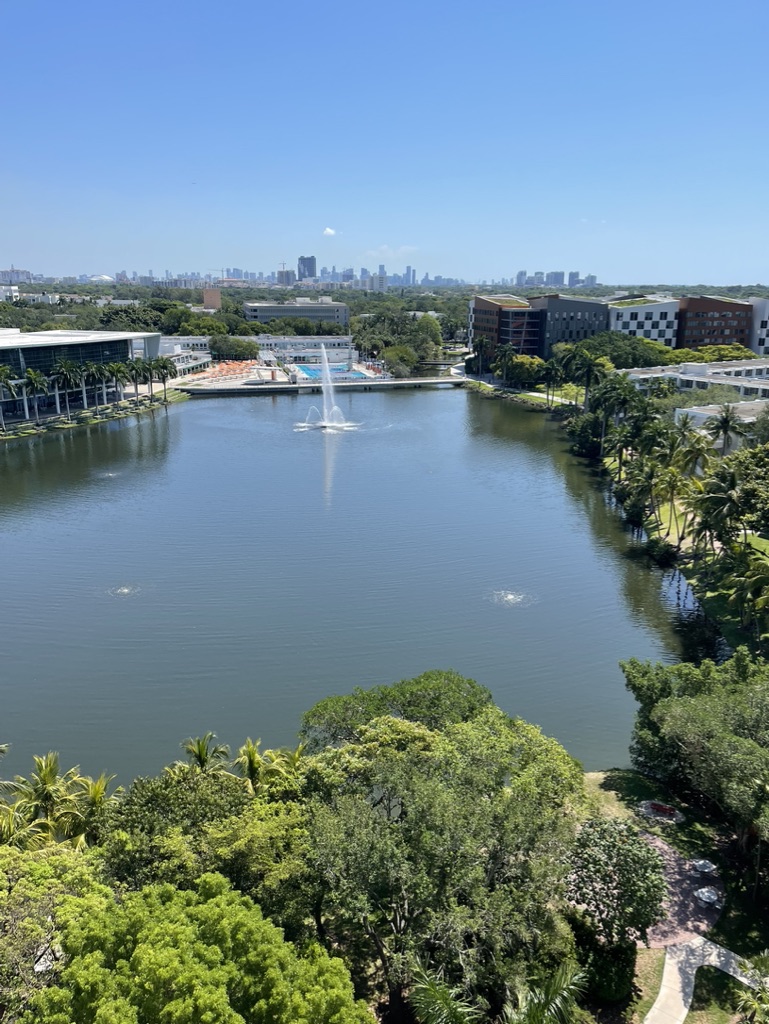
The University of Miami's proposed 30-year development agreement with Coral Gables would let the school build a 100-bed campus hospital without a separate public vote on whether a hospital belongs there, replace the city's existing cap on campus construction with a looser standard, and hand control of more than 56 city parking spaces to the university.
Those details, drawn from the 217-page filing UM submitted to the city on Thursday, June 11, emerged in a Coral Gables Gazette analysis published Tuesday, July 22. They go well beyond the park-and-expansion framework city officials highlighted when the deal surfaced publicly in late June.
Hospital as a permitted use
Under the proposed agreement, a hospital of up to 100 beds would be listed as a permitted use in the campus Multi-Use Zone. That classification means no conditional-use hearing and no discretionary commission vote on whether a hospital may operate there. A hospital larger than 100 beds would still require conditional-use approval.
The filing defines the facility broadly: a "Health Center" serving both the university and the general public, offering inpatient and outpatient care, surgery, emergency services, radiation therapy, chemotherapy and diagnostic imaging.
The university has filed no hospital site plan and has said publicly it has no specific hospital proposal. What it seeks is the zoning authority to build one later without returning for a separate use vote.
UHealth, UM's health system, already operates 700 beds across 40 South Florida locations and logged 1.7 million patient visits in fiscal year 2025, according to the Gazette's reporting. Baptist Health's Doctors Hospital sits adjacent to the campus Multi-Use Zone at 5000 University Drive.
Enrollment threshold, not a cap
The filing names 17,500 undergraduates the "Undergraduate Enrollment Mitigation Threshold," not a hard cap. If full-time-equivalent enrollment on the Coral Gables campus exceeds that number, UM must submit a traffic-mitigation report. The city gets 120 days to review before the report reaches the commission for approval by ordinance.
Nothing in the document sets a number at which enrollment must stop.
A companion provision called the On-Campus Housing Credit further softens the threshold: each new dorm bed built earns a half-student credit against the university's mitigation obligation. The agreement records 4,228 beds on campus as of the execution date.
Development cap replaced
The current agreement caps campus construction at 6.8 million square feet. The proposed deal would strike that figure and substitute a campus-wide floor-area ratio of 1.0, allowing one square foot of building for each square foot of land counted in the calculation.
The filing itself states the change "will increase the intensity of the Master Plan" but does not calculate by how much. The campus spans approximately 240.61 acres according to the legal description, but the amended code would exclude parking areas, lobbies, stairwells, elevators, basements and several other categories from the ratio calculation.
Parking spaces transferred
Paragraph 18 of the proposed agreement commits the city to transfer control and revenue from at least 56 pay-by-phone parking spaces near the campus core to the university, plus additional spaces on the public right-of-way near Levante Avenue. The filing assigns no value to the spaces and does not estimate what they generate or what the city would forgo over 30 years.
What the city gets
In exchange, UM would convey the 5.52-acre Lee Lincoln Site to the city for a park to be named Centennial Park. Mayor Vince Lago told the Miami Herald on June 30 the land is worth an estimated $50 million; that figure does not appear in the filing.
The park transfer is conditional. Under Paragraph 19, the university would hand over the land only after the city grants final, non-appealable approval of every element of the package, and only if those approvals arrive without any condition UM, in its "sole and absolute discretion," deems unacceptable.
Annual payments would start at $1,025,000 in year one and rise 4% each year, totaling roughly $57.5 million over the 30-year term.
What's missing from the public record
No independent appraisal of the Lee Lincoln Site, no fiscal-impact analysis and no valuation of the development rights or parking revenue the city would give up have been filed in the public record, according to the Gazette's review.
What happens next
The Planning and Zoning Board must review the full package before it reaches the City Commission. As of Tuesday, July 22, the city's file did not list a hearing date. Residents can monitor the city's Planning and Zoning agenda at coralgables.com or contact the Planning Department at 305-460-5211.






.jpg)