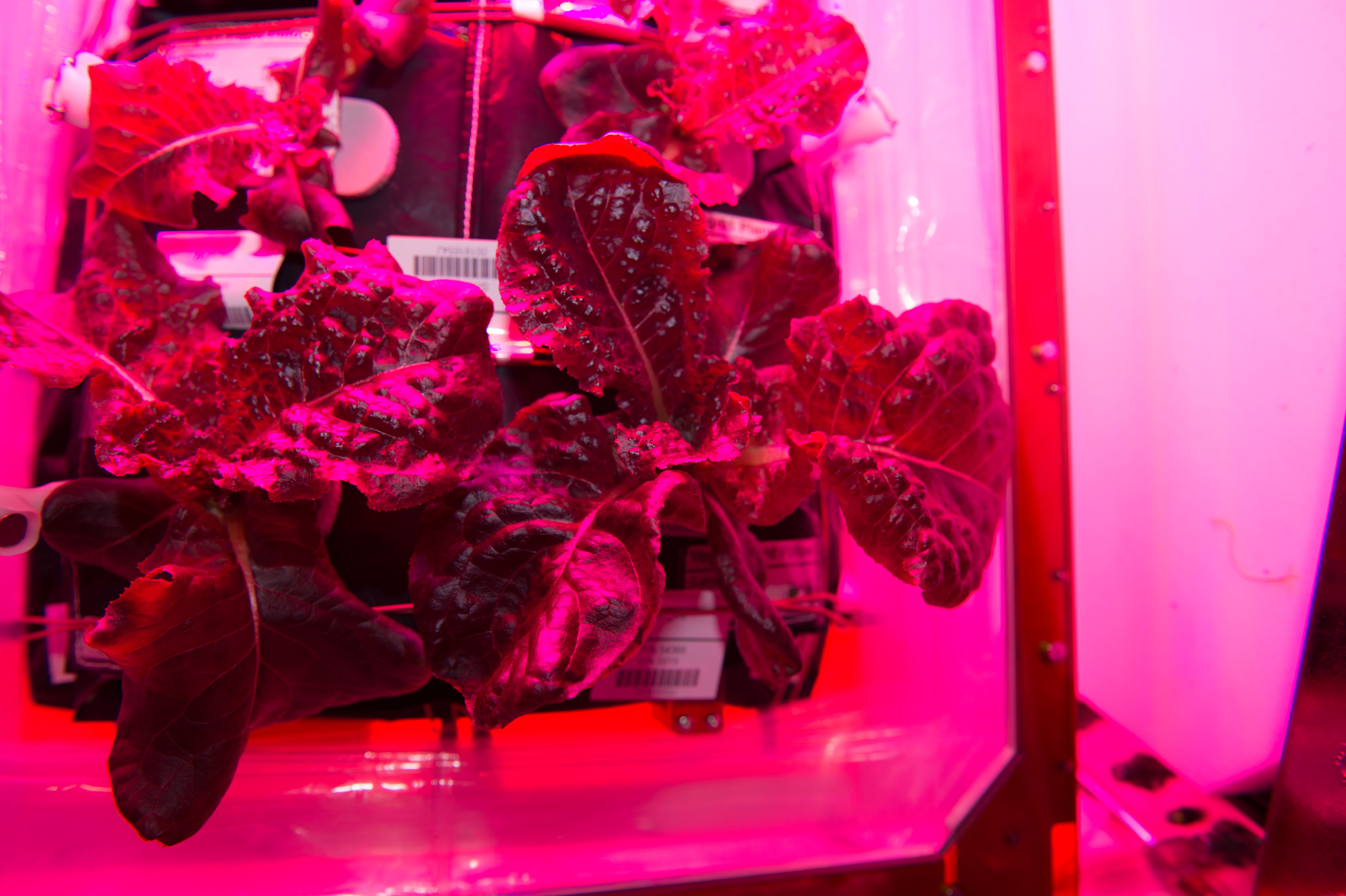
Students at Ponce de Leon Middle School are among thousands of young researchers nationwide helping identify crops that could one day feed astronauts on the Moon and Mars.
Through Fairchild Tropical Botanic Garden's Growing Beyond Earth program, classrooms at the Coral Gables school use compact growth chambers modeled after NASA's Veggie system aboard the International Space Station. Each chamber holds six plants in a clay-based growing medium beneath programmable LED lights, while a microcomputer records temperature, humidity, carbon dioxide and barometric pressure.
Students collect weekly observations and measurements before presenting their findings directly to NASA scientists.
Student research has already reached the International Space Station
Four plant cultivars tested through the Growing Beyond Earth program have already been grown aboard the International Space Station, where astronauts have eaten the harvest.
"Astronauts have eaten crops that our students helped identify," Amy Padolf, the program's founder and director, said in a report published Thursday, July 3 on Refresh Miami.
Those crops include Extra Dwarf Bok Choy, Red Robin tomatoes, Mizuna mustard greens and Chimayo peppers.
Program has expanded from Miami-Dade to hundreds of schools
Fairchild launched Growing Beyond Earth in 2015 with funding from NASA's Exploration Research and Technology Programs. What began as a Miami-Dade County initiative now serves more than 10,000 students in more than 500 schools across the United States, Puerto Rico and 13 other countries, according to Fairchild.
During the 2025-26 school year approximately 100 public, charter and private schools across Miami-Dade, Broward and Palm Beach counties participated.
To date, students have tested more than 275 edible plant varieties. About 40 have been selected by NASA for additional testing at Kennedy Space Center, Padolf said.
The research supports NASA's Artemis program and future Mars missions, where astronauts will need to supplement packaged food by growing crops on-site.
Students begin by testing crops under simulated space conditions
Schools entering the program begin with the Novel Crops experiment, a 28-day study designed to determine which plant varieties perform best under conditions that simulate the International Space Station.
This year's crops included papalo, dwarf nasturtium, Thai basil, fennel, dwarf gray sugar peas and amaranth.
Schools can apply through July 31
Schools interested in joining the 2026-27 Growing Beyond Earth cohort must apply through Fairchild Tropical Botanic Garden by Friday, July 31. Information and applications are available at fairchildgarden.org/science-and-education/science/gbe.
Visitors can explore space plant research at Fairchild
Residents interested in seeing the research firsthand can visit Fairchild's Innovation Studio at 10901 Old Cutler Road, across from the butterfly garden.
The studio houses a clinostat, a device that simulates microgravity by slowly rotating plants so gravity never acts as a constant directional force, allowing researchers to study how plants may grow in space. The next round of student research will begin with schools selected for the 2026-27 Growing Beyond Earth cohort.



.jpg)